
Last reviewed
What Montessori actually means
Montessori is an approach to early education developed by the Italian doctor Maria Montessori. Instead of an adult leading the whole group through set lessons, children choose their own activities from a carefully prepared room and work at their own pace, with the adult observing and guiding rather than directing. The idea is that young children learn best through hands-on, self-chosen activity.
A recognisable Montessori setting is built on a few core ideas:
- Child-led learning: children pick what to work on and stay with it as long as they like, which builds concentration and independence.
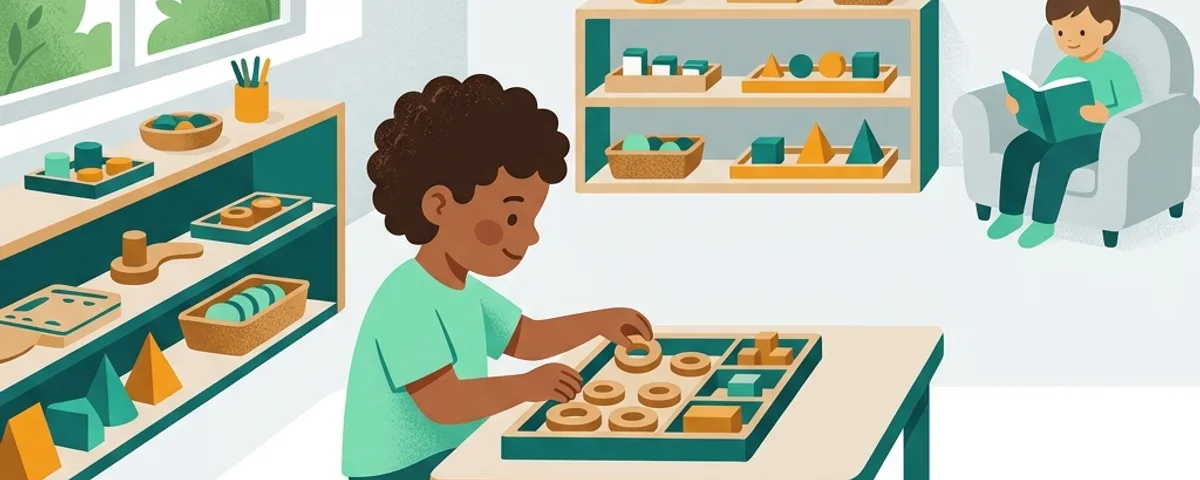
- A prepared environment: low shelves, child-sized furniture and materials laid out in order, all within reach so children can help themselves without waiting for an adult.
- Mixed-age groups: classes usually span about three years, so younger children learn by watching older ones and older children consolidate skills by helping.
- Practical-life and sensorial materials: real, purposeful tasks like pouring, buttoning, sweeping and food preparation, plus specially designed materials for exploring size, shape, colour, weight, texture and sound.
- Uninterrupted work periods: long, calm stretches of time so a child can settle deeply into an activity rather than being moved on every few minutes.
"Montessori" in Ireland: a style, not a protected title
Here is the point that surprises many parents: in Ireland "Montessori" is not a legally protected or separately regulated term. There is no rule reserving the word for services that follow the method faithfully or whose staff hold particular Montessori qualifications. Over the years "Montessori" has become almost a general word for preschool or playschool, so a service can call itself Montessori whether it runs a full Montessori programme or simply uses some of the ideas.
What this means in practice: the name on the door tells you the setting's style and ambition, but not the depth of training behind it. A genuinely strong Montessori and a preschool that just borrows the label can both advertise the same word, so the quality really does vary from one setting to the next, and visiting is the only reliable way to tell.
It is still fully regulated, by Tusla
Even though the Montessori label is not policed, the childcare service itself absolutely is. Under Irish law, any preschool, creche or Montessori service caring for young children must be registered with Tusla, the Child and Family Agency, and is inspected against national early-years regulations covering safety, health, staff vetting, ratios and standards of care. So a Montessori setting has to meet exactly the same statutory bar as any other preschool.
You can look up any service on Tusla's public register, and you are entitled to ask a setting for its most recent inspection report. See citizensinformation.ie: regulation of pre-school childcare services and the Tusla register of early years services.
Montessori and the free preschool year
Most Montessori preschools in Ireland take part in the ECCE scheme, the free preschool programme that covers the year or two before primary school. You do not apply to a government office; you enrol your child directly with the Montessori service and it registers them for ECCE. That means many families get their child's free preschool entitlement inside a Montessori-style setting.
All ECCE services, Montessori included, are expected to work within Aistear, Ireland's national early childhood curriculum framework, which is itself built around learning through play and child-centred practice. A good Montessori weaves its own approach through the themes of Aistear rather than treating them as separate things. You can read more at NCCA, Aistear, the early childhood curriculum framework and gov.ie: the ECCE preschool programme.
How Montessori differs from play-based settings
Parents often ask how a Montessori differs from an ordinary play-based or Aistear-focused preschool. Both are warm, child-centred and regulated the same way, the difference is emphasis:
- Montessori leans on individual free choice from set materials, mixed-age rooms and long solo or small-group work periods, with a strong focus on independence and self-correction.
- Play-based / Aistear settings tend to use more open-ended and imaginative play, themed activities and adult-led group times, often in single-age rooms.
- In reality, most Irish preschools blend both. Plenty of "Montessori" rooms include free play, and plenty of play-based rooms use Montessori materials. Neither is better across the board, the right fit depends on your child and the individual setting.
Because quality varies, visit and ask
Since the label alone guarantees little, treat choosing a Montessori exactly as you would choosing any preschool: go and see it. A short visit tells you more than any brochure.
- Visit while the room is busy and watch how settled and absorbed the children are.
- Ask about the manager's and staff's Montessori training and qualifications, this is where "Montessori" settings differ most.
- Ask to see the most recent Tusla inspection report, and check the service on Tusla's register.
- Check the child-to-staff ratios and how new children are helped to settle in.
- Confirm whether the free ECCE preschool year is offered and what the daily routine looks like.
For a fuller walkthrough of what to look for and questions to ask, see our guide on how to choose a creche or preschool, and when you are ready to compare options near you, browse creches and preschools on HeadStart.