
St Louis Community School
Kiltimagh, Mayo
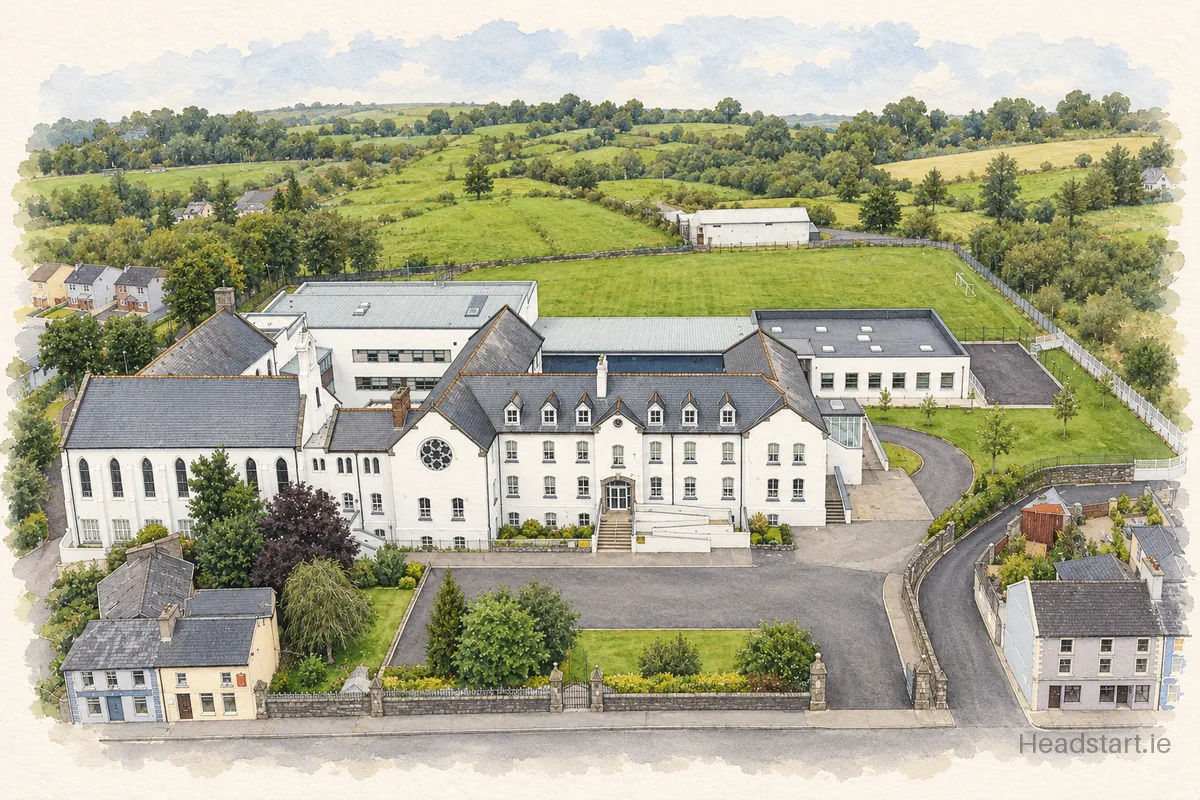
Key facts
- Mixed
- Pupils enrolled
- 701 larger than the median Irish post-primary school (585 pupils)
- Girls and boys
- 342 girls, 359 boys
- Ethos
- Inter Denominational
- Teaching through Irish
- No subjects taught through Irish
- Roll number
- 91494R the Department of Education reference for this school
School details
Location
About
St Louis Community School is a co‑educational, multi‑denominational post‑primary institution in Kiltimagh that offers a comprehensive curriculum spanning the Junior Cycle, Junior Certificate Schools Programme, Transition Year, Leaving Certificate Applied, Leaving Certificate and adult education. The school places teaching and learning at the heart of its ethos, embracing innovative and progressive approaches through close collaborations with third‑level partners such as Dublin City University and other universities. Staff are encouraged to adopt active teaching methodologies, with many having completed the Instructional Leadership programme, and the school was the first pilot in Mayo for the Droichead induction programme for newly qualified teachers. The campus provides modern sports facilities catering for Gaelic football, soccer, basketball, volleyball, indoor football, athletics, table tennis and a range of performing‑arts and extracurricular activities. A well‑equipped cafeteria serves wholesome meals at reasonable prices, and dedicated study periods are offered each evening (4.15‑6.15 pm, Monday‑Thursday; 2‑4 pm Friday) plus a morning study room. Robust special educational needs and pastoral‑care programmes ensure that every student can develop academically, socially and emotionally in a safe, supportive environment.
History
In September 1897, six Sisters of the St Louis Order arrived from Monaghan to Kiltimagh and established a technical school for parish children, soon followed by a school for young ladies. By 1908 the institution had become primarily a boarding school for girls, gaining national recognition for lace‑making and Irish language proficiency. Boys were first admitted in 1973 and the boarding element was phased out. The Sisters vacated the premises in 1992, and in 1993 St Louis Community School was founded through the amalgamation of St Louis Secondary School and Coláiste Raisteirí Vocational School. The school’s trustees are Le Cheile and the Mayo, Sligo & Leitrim Education and Training Board.
Applying to St Louis Community School
For a September 2027 place, a school's formal admissions process cannot begin before 1 October 2026. The school sets its own opening and closing dates in its annual admission notice.
National term dates 2026/27
Irish schools follow a standardised school year, so these nationwide post-primary school dates apply broadly to St Louis Community School. Individual schools set their own discretionary closure days, confirm exact dates with the school.
- October Mid-Term Break: Mon 26 Oct – Fri 30 Oct 2026
- Christmas Holidays: Wed 23 Dec 2026 – Tue 5 Jan 2027
- February Mid-Term Break: Mon 15 Feb – Fri 19 Feb 2027 (primary schools: Thu 18 Feb – Fri 19 Feb 2027)
- Easter Holidays: Mon 22 Mar – Sun 4 Apr 2027
Primary schools close for the last two days of the February mid-term week and may use discretionary days to take the full week, so their break can be shorter than post-primary schools'.
Frequently asked questions about St Louis Community School
How many pupils attend St Louis Community School?
St Louis Community School has 701 pupils enrolled, 342 girls and 359 boys. That makes it larger than the median Irish post-primary school, which has 585 pupils.
Is St Louis Community School a DEIS school?
No. St Louis Community School is not part of DEIS, the Department of Education programme of additional supports for schools serving communities at risk of educational disadvantage. Not holding DEIS status says nothing about how good a school is, only about the profile of the community it serves.
What is the ethos of St Louis Community School?
St Louis Community School has an Inter Denominational ethos. It is a mixed post-primary school.