
Dunmore Community School
Galway
Key facts
- Mixed
- Pupils enrolled
- 367 smaller than the median Irish post-primary school (585 pupils)
- Girls and boys
- 164 girls, 203 boys
- Ethos
- Inter Denominational
- Teaching through Irish
- No subjects taught through Irish
- Roll number
- 91414Q the Department of Education reference for this school
School details
Location
About
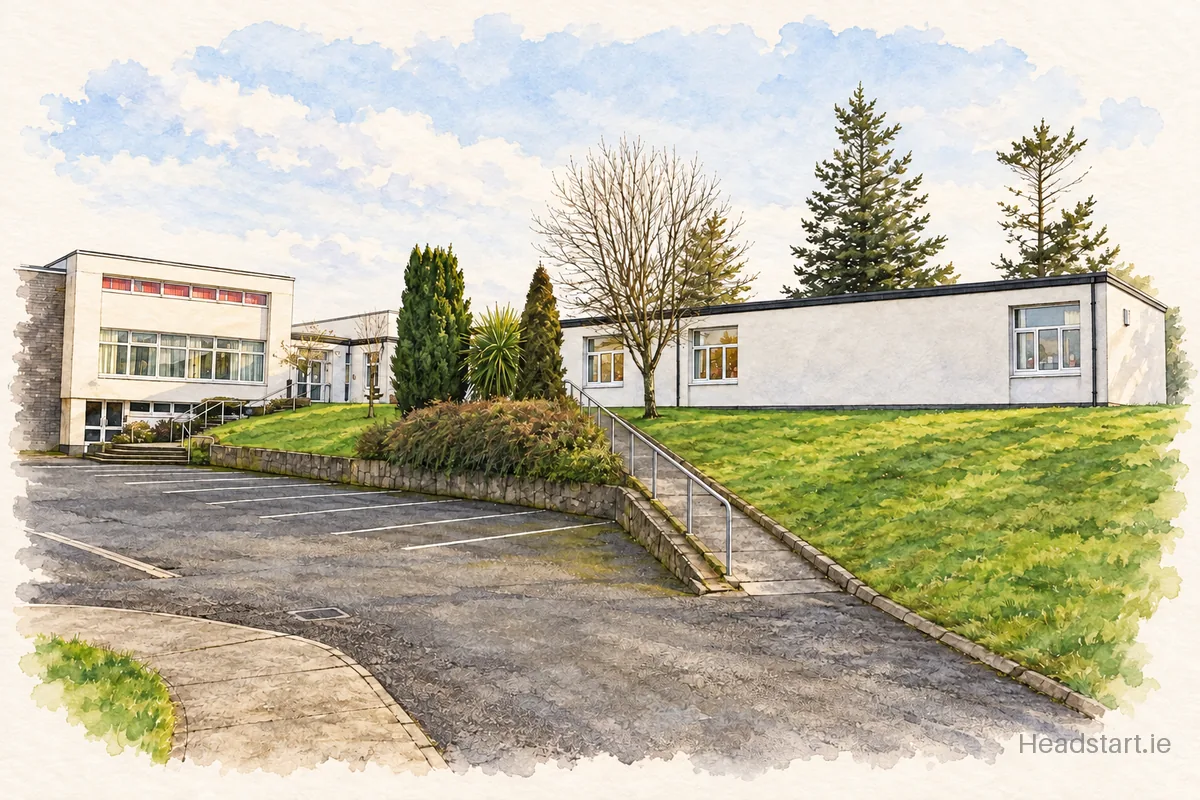
Dunmore Community School is a mixed post‑primary institution in County Galway that delivers an inclusive, comprehensive education to the local community. The school’s ethos centres on a balanced curriculum that combines strong academic expectations with a wide range of sport and extracurricular activities, encouraging the development of lifelong skills alongside high examination results. Modern teaching spaces include upgraded original buildings and a contemporary extension opened in 1999, providing specialised rooms for metalwork, wood technology, graphics, and science, as well as well‑equipped sports facilities. A recent deep‑energy retrofit undertaken in the summer of 2019 has transformed the campus into a more sustainable learning environment. The refurbishment introduced high‑performance windows and doors, external insulation, a new gas‑heated system with thermostatic control, solar panels, and LED external lighting, reducing both heat loss and electricity consumption. With over 350 pupils currently enrolled, a staff team of more than 50, and five decades of educational provision, the school offers a supportive setting where students can thrive academically, socially and personally.
History
Dunmore Community School was established in 1990 through the amalgamation of two local secondary schools: the Incarnate Word College and St Patrick’s Vocational School. The Incarnate Word College, founded by the Sisters of the Incarnate Word in 1925, opened a new building in 1967; the Sisters withdrew in 1979 and the Mercy Sisters assumed management. St Patrick’s Vocational School opened in 1953 and saw successive extensions, including a metalwork room (1962), a recreational and secretarial suite (1978), and three additional classrooms (1984). The community school occupies the Incarnate Word site, with the original structure upgraded and a modern extension completed in 1999, officially opened by Minister Michael Martin. In 2019 the school was selected as a pilot for a comprehensive deep‑energy retrofit, further modernising its facilities.
Applying to Dunmore Community School
For a September 2027 place, a school's formal admissions process cannot begin before 1 October 2026. The school sets its own opening and closing dates in its annual admission notice.
National term dates 2026/27
Irish schools follow a standardised school year, so these nationwide post-primary school dates apply broadly to Dunmore Community School. Individual schools set their own discretionary closure days, confirm exact dates with the school.
- October Mid-Term Break: Mon 26 Oct – Fri 30 Oct 2026
- Christmas Holidays: Wed 23 Dec 2026 – Tue 5 Jan 2027
- February Mid-Term Break: Mon 15 Feb – Fri 19 Feb 2027 (primary schools: Thu 18 Feb – Fri 19 Feb 2027)
- Easter Holidays: Mon 22 Mar – Sun 4 Apr 2027
Primary schools close for the last two days of the February mid-term week and may use discretionary days to take the full week, so their break can be shorter than post-primary schools'.
Frequently asked questions about Dunmore Community School
How many pupils attend Dunmore Community School?
Dunmore Community School has 367 pupils enrolled, 164 girls and 203 boys. That makes it smaller than the median Irish post-primary school, which has 585 pupils.
Is Dunmore Community School a DEIS school?
No. Dunmore Community School is not part of DEIS, the Department of Education programme of additional supports for schools serving communities at risk of educational disadvantage. Not holding DEIS status says nothing about how good a school is, only about the profile of the community it serves.
What is the ethos of Dunmore Community School?
Dunmore Community School has an Inter Denominational ethos. It is a mixed post-primary school.