
Calasanctius College
Oranmore, Galway
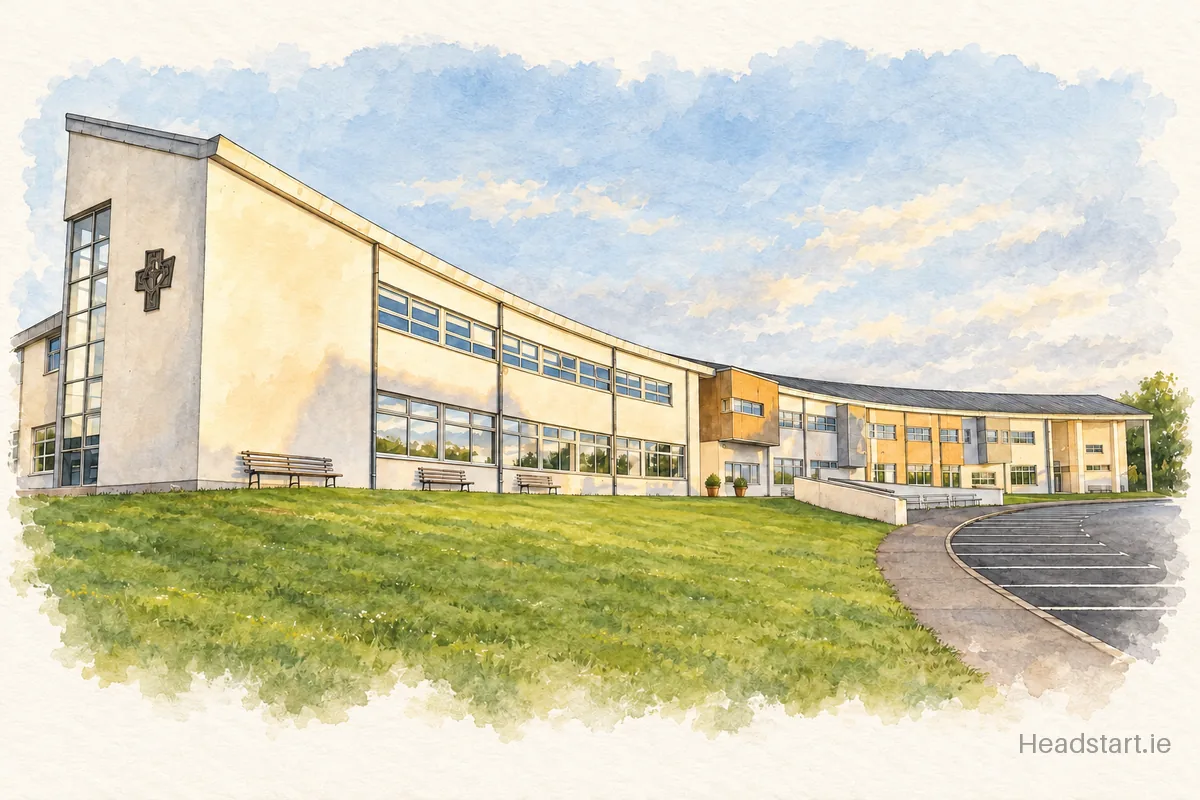
Key facts
- Mixed
- Pupils enrolled
- 906 larger than the median Irish post-primary school (585 pupils)
- Girls and boys
- 408 girls, 498 boys
- Ethos
- Catholic
- Teaching through Irish
- No subjects taught through Irish
- Roll number
- 63100I the Department of Education reference for this school
School details
Location
About
Calasanctius College is a Catholic, co-educational voluntary secondary school in Oranmore, County Galway. Enrolment is approximately 900 students drawn from Oranmore and the surrounding area. The school operates under the trusteeship of CEIST (Catholic Education, An Irish Schools Trust). The curriculum includes the Junior Cycle, Transition Year, the Leaving Certificate, and the Leaving Certificate Vocational Programme (LCVP). A range of extra-curricular activities is available, including Gaisce, the Green Schools programme, music, sports, and a school musical. The school states its aim as promoting the balanced development of students within an inclusive community and preparing them for third-level education and the wider world. Facilities on site include a sports hall, library, oratory, four science laboratories, home economics rooms, an art room, a language laboratory, a computer laboratory, woodwork and construction rooms, a technical graphics room, social studies rooms, a guidance suite, and music rooms, along with a general purpose area.
History
Four Presentation Sisters from Galway founded a convent in Oranmore on 23 May 1861 at the request of the Bishop, Most Rev. Dr. McEvilly, with a donation from Councillor John Blake. The first convent was known locally as the 'Hotel' near the present Moorings Restaurant, and an out-building became a college. In 1869 the Sisters moved into the Parochial House, purchased for £600. The old National College was built from October 1886, and a new convent followed three years later. A hall built in 1916 for Home Economics classes became the first Secondary College when blessed on 27 August 1946, the feast of St. Joseph Calasanctius. A boarding college for girls opened the following year, and a major extension was erected in 1963. Boys were first enrolled in 1973. Boarding ceased from 1987, and dormitories became science laboratories and classrooms. The Sisters withdrew from teaching in 1994, and trusteeship transferred to CEIST in 2008. New school buildings were sanctioned in 2001 and officially opened in 2006.
Applying to Calasanctius College
For a September 2027 place, a school's formal admissions process cannot begin before 1 October 2026. The school sets its own opening and closing dates in its annual admission notice.
National term dates 2026/27
Irish schools follow a standardised school year, so these nationwide post-primary school dates apply broadly to Calasanctius College. Individual schools set their own discretionary closure days, confirm exact dates with the school.
- October Mid-Term Break: Mon 26 Oct – Fri 30 Oct 2026
- Christmas Holidays: Wed 23 Dec 2026 – Tue 5 Jan 2027
- February Mid-Term Break: Mon 15 Feb – Fri 19 Feb 2027 (primary schools: Thu 18 Feb – Fri 19 Feb 2027)
- Easter Holidays: Mon 22 Mar – Sun 4 Apr 2027
Primary schools close for the last two days of the February mid-term week and may use discretionary days to take the full week, so their break can be shorter than post-primary schools'.
Frequently asked questions about Calasanctius College
How many pupils attend Calasanctius College?
Calasanctius College has 906 pupils enrolled, 408 girls and 498 boys. That makes it larger than the median Irish post-primary school, which has 585 pupils.
Is Calasanctius College a DEIS school?
No. Calasanctius College is not part of DEIS, the Department of Education programme of additional supports for schools serving communities at risk of educational disadvantage. Not holding DEIS status says nothing about how good a school is, only about the profile of the community it serves.
What is the ethos of Calasanctius College?
Calasanctius College has a Catholic ethos. It is a mixed post-primary school.